


J&K Assembly Witnesses Heated Debate Over Private Bill No. 6 on EWS Reservation
Jammu, March 30:
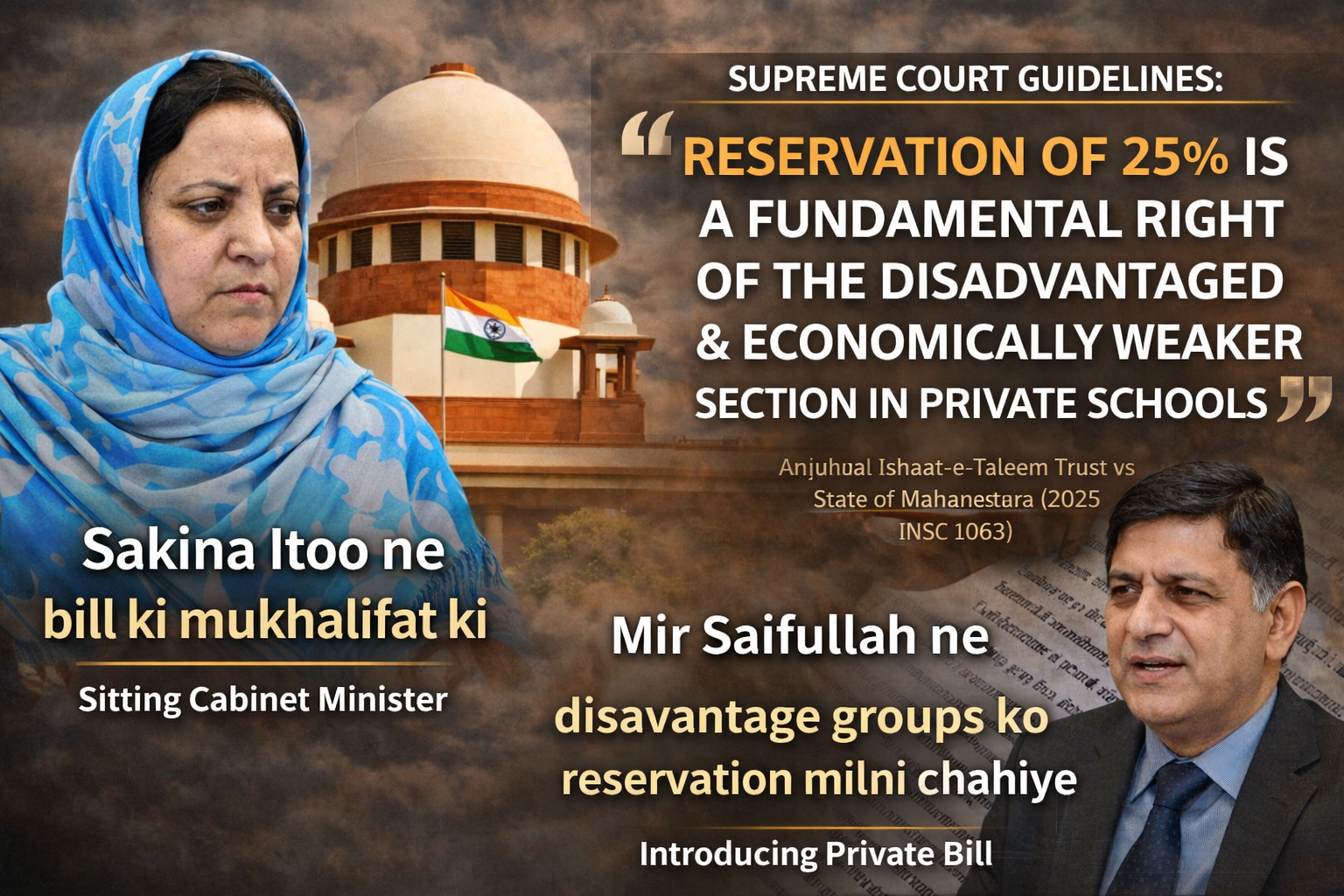 The Jammu and Kashmir Legislative Assembly witnessed a heated debate over Private Member Bill No. 6, introduced by MLA Mir Saifullah, seeking implementation of 25% reservation for Economically Weaker Sections (EWS) and Below Poverty Line (BPL) students in private educational institutions.
The bill aims to ensure equitable access to quality education by extending reservation benefits to underprivileged children in private schools and colleges across the Union Territory.
Supreme Court Mandate Highlighted
During the debate, members referred to the judgment of the Hon’ble Supreme Court of India in
Anjuman Ishaat-e-Taleem Trust vs State of Maharashtra & Others, wherein the Court examined the scope of the Right of Children to Free and Compulsory Education Act, 2009.
Particularly, Para ‘B’ of the judgment clearly states that:
25% reservation for weaker sections and disadvantaged groups under Section 12(1)(c) of the RTE Act is mandatory
The provision is aimed at achieving universalisation of elementary education and social inclusion
Excluding such children from private institutions would defeat the constitutional objective of equality in education under Article 21A
The Court further observed that any dilution of this mandate would undermine the fundamental right to education guaranteed to children.
Allegations of Non-Implementation in J&K
Legislators alleged that despite this binding mandate since 2009, Jammu and Kashmir has failed to effectively implement the 25% EWS reservation, raising concerns over continued violation of Supreme Court directions.
Inequality in Education System
The bill highlighted widening disparities between private and government education systems. It was pointed out that many government employees, including teachers, prefer private schooling for their children, resulting in better academic outcomes for privileged sections, while students in government schools continue to face declining quality standards.
Concerns were also raised over poor enrolment in several government schools despite surplus teaching staff, indicating inefficiencies in resource allocation.
Government Faces Criticism
The proposal faced opposition from Education Minister Sakina Itoo, despite claims that the bill carried no financial implications.
MLA Mir Saifullah urged the government to support the bill, while Chief Minister Omar Abdullah was also called upon to reconsider the stance.
Senior MLA Nizamuddin Bhat criticized the government, alleging lack of due scrutiny in legislative decision-making.
Administrative Concerns and Clarification
Amid the debate, social media-based allegations regarding irregularities in transfer and posting processes were mentioned; however, these remain unverified and unofficial.
Responding to the issue, Minister Sakina Itoo stated that:
No recommendations for transfers will be entertained
All attached staff will be detached and sent back to original postings
No MLA or individual should approach her office regarding such matters
She emphasized that administrative functioning would remain transparent and disciplined.
Conclusion
The debate over Private Member Bill No. 6 has evolved into a significant legal and policy issue, with the Supreme Court’s ruling in Anjuman Ishaat-e-Taleem Trust vs State of Maharashtra (2025 INSC 1063) clearly reinforcing that 25% EWS reservation is a mandatory legal obligation, not a discretionary policy.